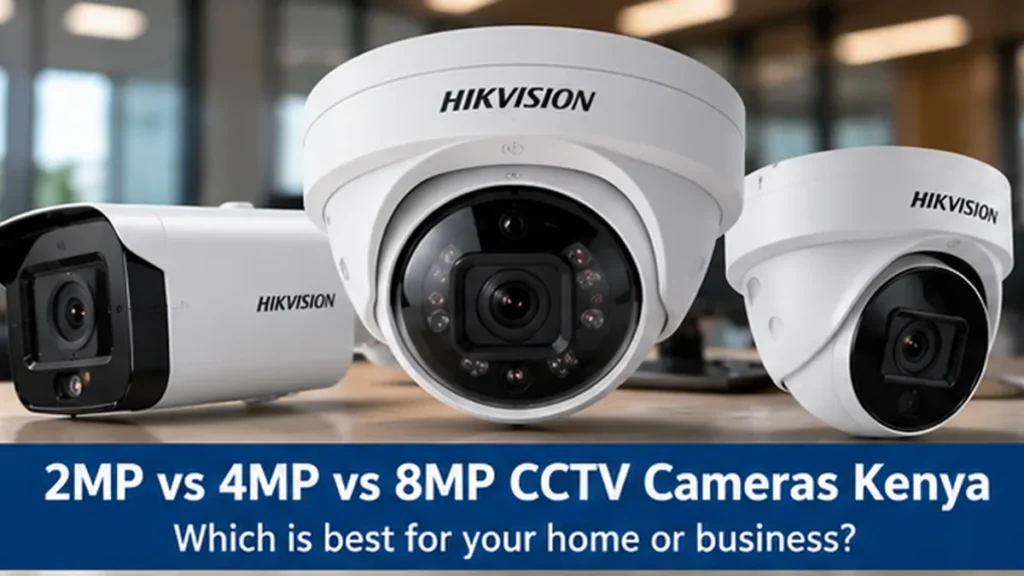
2MP vs 4MP vs 8MP CCTV Cameras in Kenya: Which Is Best?
Introduction
2MP vs 4MP vs 8MP CCTV cameras Kenya buyers compare can produce different levels of image detail, but choosing the highest resolution does not automatically mean choosing the best security system.
Imagine installing CCTV at your Nairobi shop. You want to see customers entering, monitor the cashier and keep an eye on your stock. Would a 2MP camera be enough, or should you invest in 4MP or 8MP cameras?
The answer depends on what you need to see, how far away the subject is, the lighting conditions and how long you need to store recordings.
In this guide, Marimbu Heritage Technologies explains the differences between 2MP, 4MP and 8MP CCTV cameras, where each may be suitable and how to choose the right option for your home or business in Kenya.
What Does MP Mean in CCTV Cameras?
MP stands for megapixels. It describes the number of pixels in an image, measured in millions.
In simple terms, more megapixels can provide more image detail when the camera, lens, lighting and recording settings are suitable.
Common CCTV resolutions include:
- 2MP: approximately 1920 × 1080 pixels, commonly called Full HD.
- 4MP: often approximately 2560 × 1440 pixels.
- 8MP: approximately 3840 × 2160 pixels, commonly called 4K.
Exact resolutions can vary by camera model. Always check the manufacturer’s specifications before buying.
Remember that megapixels are only one part of image quality. Lens quality, sensor performance, lighting, compression and camera placement also matter.
2MP vs 4MP vs 8MP CCTV Cameras Kenya: The Main Differences
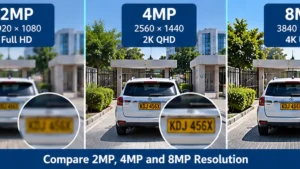
The main difference is the amount of image detail each resolution can capture under suitable conditions.
- 2MP: suitable for many basic surveillance needs.
- 4MP: provides more pixels for applications where additional detail is useful.
- 8MP: can provide finer detail and more flexibility when viewing or cropping footage, provided the rest of the system supports it.
A higher-resolution camera can also require more storage and network bandwidth, depending on its settings.
1. 2MP CCTV Cameras: When Are They Enough?
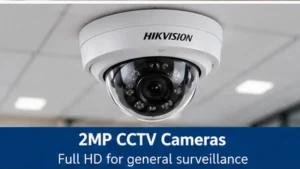
A 2MP camera can provide Full HD footage and may be suitable for general surveillance where the viewing distance and identification requirements are modest.
Potential applications include:
- Small shops
- Home entrances
- Corridors
- Small offices
- General indoor monitoring
- Areas where broad activity monitoring is the main goal
For example, a small shop may need to see when someone enters, whether the counter is occupied and general movement around the premises.
A well-positioned 2MP camera may meet those needs.
However, if you need to identify small details from a distance, a higher resolution or a different lens may be necessary.
Choose 2MP when: the budget is limited and the camera’s intended viewing area does not require extensive detail.
2. 4MP CCTV Cameras: A Practical Middle Ground
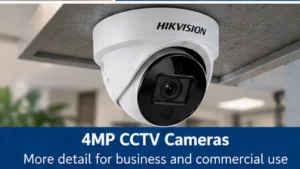
A 4MP camera captures more pixels than a 2MP camera and can provide additional detail when installed and configured properly.
It may be suitable for:
- Retail shops
- Offices
- Building entrances
- Reception areas
- Small warehouses
- Business premises that need more detail than basic surveillance provides
For example, a business monitoring its entrance and customer area may benefit from the extra image detail available from a suitable 4MP camera.
However, results depend on lighting, lens choice, distance and camera placement. A poorly positioned 4MP camera may produce less useful footage than a well-positioned 2MP camera.
Choose 4MP when: you need a balance between image detail, system cost and storage requirements.
3. 8MP CCTV Cameras: When Is 4K Worth It?
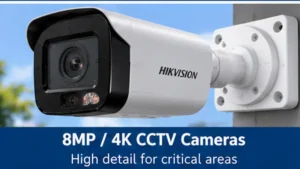
An 8MP camera commonly offers 4K resolution, providing substantially more pixels than a 2MP camera.
It may be appropriate for:
- Large retail spaces
- Warehouses
- Commercial entrances
- Larger offices
- Areas where fine image detail is important
- Installations that benefit from cropping or zooming into recorded footage
Higher resolution can be helpful when reviewing recorded images, but it cannot guarantee facial identification or readable number plates at every distance.
The lens, lighting, shutter settings, subject movement and angle all affect the result.
An 8MP camera may also produce larger video files or require more processing and network capacity, depending on the compression and recording settings.
Choose 8MP when: your surveillance requirements justify the additional detail and your recorder, network and storage can support it.
4. Image Detail: What Can You Actually See?
The practical value of higher resolution depends on what you want to identify.
Consider three examples:
- Monitoring general movement: 2MP may be sufficient in an appropriate location.
- Monitoring a shop entrance: 4MP may provide useful additional detail, depending on the distance and field of view.
- Monitoring a wide area where detailed review is important: 8MP may be worth considering if the camera and lens are suitable.
Higher resolution does not automatically mean that every face or object will be clear. If a person is far away, moving quickly or poorly illuminated, the image may still lack useful detail.
Before selecting a camera, identify the specific area you want to monitor and the level of detail you need from that location.
5. Storage Requirements: Does Higher Resolution Use More Space?
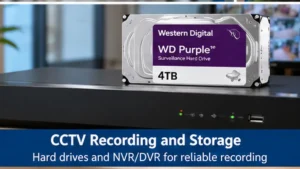
Higher-resolution footage can require more storage, particularly when recording settings, frame rates and compression are similar.
Your storage requirements depend on:
- Number of cameras
- Resolution
- Frame rate
- Compression format
- Recording hours
- Continuous or motion-based recording
- Required retention period
For example, a system with eight cameras recording continuously will generally require more storage than a system with four cameras using similar settings.
If you need recordings for 14, 30 or more days, make sure the hard drive capacity is calculated for your specific setup.
Do not choose the cameras first and ignore storage. Plan the complete recording system together.
6. Bandwidth and Network Requirements
IP CCTV cameras send video through a network. Higher resolution can increase the amount of data being transmitted, although the actual bandwidth also depends on compression, frame rate and scene activity.
For a network CCTV system, consider:
- Network switch capacity
- PoE support and power budget
- Ethernet cabling
- Recorder throughput
- Remote viewing requirements
- Network bandwidth
- Number of simultaneous camera streams
A properly planned system can help prevent network bottlenecks and recording problems.
For larger installations, professional network design may be worthwhile. Explore our Network Solutions in Kenya and Structured Cabling Solutions in Kenya pages for related information.
7. Price: Is 8MP Always the Best Investment?
Not necessarily.
Higher-resolution cameras may cost more, but the total project cost also includes the recorder, storage, cabling, switches, installation and configuration.
A 4MP camera may be a better investment than an 8MP camera if it meets your security objectives at a lower overall cost.
Likewise, an 8MP camera may be justified where additional detail is important.
Compare the complete system rather than buying based on megapixels alone.
Quick Comparison: 2MP vs 4MP vs 8MP
| Feature | 2MP | 4MP | 8MP |
|---|---|---|---|
| Typical resolution | 1920 × 1080 | 2560 × 1440 | 3840 × 2160 |
| Common description | Full HD | Higher-than-Full-HD | 4K |
| Image detail | Basic to good | More detail | Finer detail |
| Storage needs | Often lower | Often higher | Often higher still |
| Bandwidth needs | Often lower | Often higher | Often higher still |
| Typical use | General monitoring | Business surveillance | Detail-focused surveillance |
| Best choice | Basic requirements | Balanced requirements | When extra detail is needed |
These are general comparisons. Actual performance and storage requirements vary by model and configuration.
Which CCTV Resolution Is Best for a Kenyan Shop?
For a small shop, start by identifying the areas that need monitoring.
You may want to cover:
- Main entrance
- Cashier
- Customer area
- Stock room
- Back entrance
A 2MP camera may be sufficient for general monitoring in some locations. A 4MP camera may be worth considering where additional detail is useful, such as at the entrance or counter.
An 8MP camera may be appropriate for a particular area where fine detail is important, but you may not need every camera to have the same resolution.
A mixed system can sometimes provide better value than installing the highest resolution everywhere.
Which CCTV Resolution Is Best for an Office?
An office may need surveillance around reception, entrances, corridors, parking areas and storage rooms.
For general monitoring, 2MP or 4MP cameras may be sufficient, depending on the location and required detail.
For a wide reception area or another location requiring closer review of footage, 4MP or 8MP may be worth considering.
Choose each camera according to its role rather than using one resolution automatically throughout the building.
Which CCTV Resolution Is Best for a Warehouse?
Warehouses can have high ceilings, long aisles, loading bays and large open spaces.
For these environments, resolution must be considered together with lens selection, mounting height, lighting and viewing distance.
An 8MP camera may be useful for a wide area where additional detail is needed. However, a suitable lens and a better camera position may be just as important.
Some warehouses benefit from combining fixed cameras with PTZ cameras where active monitoring of larger areas is required.
Can 8MP CCTV Identify Vehicle Number Plates?
An 8MP camera does not automatically guarantee readable number plates.
Number-plate capture depends on:
- Distance from the vehicle
- Camera angle
- Vehicle speed
- Lighting
- Headlight glare
- Lens and field of view
- Shutter settings
- Camera positioning
If number-plate recognition is a priority, consider a camera specifically suited to that purpose and have the installation assessed for the required capture conditions.
Does Higher Resolution Improve Night Vision?
Not by itself.
A higher megapixel count does not guarantee better night-time performance.
Night footage also depends on the image sensor, lens, available light, infrared illumination, exposure settings and movement in the scene.
When comparing cameras, check night-time sample footage and the manufacturer’s low-light specifications rather than relying only on the resolution number.
What Else Should You Check Before Buying a CCTV Camera?
Before buying a 2MP, 4MP or 8MP camera, check:
- Lens and field of view: Will the camera cover the intended area?
- Low-light performance: Will it produce useful footage after dark?
- Weather protection: Is it suitable for the intended outdoor environment?
- Recorder compatibility: Can your DVR or NVR support the camera and its resolution?
- Storage: Can you keep recordings for the required number of days?
- Network capacity: Can the switches and cabling support the system?
- Installation position: Will the camera capture the right angle and level of detail?
- Future expansion: Can you add more cameras if your needs change?
These checks can help you avoid paying for features that do not improve your actual surveillance requirements.
Hikvision CCTV Cameras: Which Resolution Should You Choose?
Hikvision offers CCTV models across different resolutions and camera designs. The right model depends on the application, features and specifications of the particular product.
When selecting a Hikvision camera, compare the resolution alongside the lens, low-light technology, weather protection, recorder compatibility and intended viewing distance.
At Marimbu Heritage Technologies, we can help you compare suitable CCTV equipment for your home, shop, office, school or warehouse in Kenya.
Common Mistakes When Choosing CCTV Resolution
Buying the Highest Resolution Automatically
Higher resolution is useful only when it meets a real surveillance need.
Ignoring the Lens
The lens determines how wide or narrow the camera’s view is and affects the detail captured at a particular distance.
Underestimating Storage
Higher-resolution footage can increase storage needs, depending on recording settings.
Ignoring Night-Time Conditions
A camera may perform differently in daylight and darkness.
Using the Same Camera Everywhere
Entrances, cashiers, corridors and outdoor perimeters may have different requirements.
Forgetting Recorder Compatibility
Confirm that your DVR or NVR supports the intended cameras and recording settings.
How Marimbu Heritage Technologies Can Help
Marimbu Heritage Technologies – Innovate. Connect. Grow.
We provide technology products and solutions for homes, businesses and institutions in Kenya, including:
- Hikvision CCTV cameras
- IP cameras and NVRs
- DVR recording systems
- PoE switches
- CCTV storage
- Structured cabling
- Network equipment
- UPS and power protection
Whether you need a basic CCTV setup for a shop or a higher-resolution system for a warehouse, we can help you identify equipment suited to your needs and budget.
Contact Marimbu Heritage Technologies for CCTV product guidance and a quotation.
Frequently Asked Questions
Is 4MP better than 2MP CCTV?
A 4MP camera captures more pixels than a 2MP camera and can provide additional detail under suitable conditions. The result still depends on lens quality, lighting, distance and camera positioning.
Is 8MP the same as 4K?
An 8MP CCTV camera commonly uses a resolution of approximately 3840 × 2160 pixels, which is known as 4K UHD. Check the actual model specifications.
Does 8MP CCTV require more storage?
It often does when other recording settings are similar. The actual storage requirement depends on compression, frame rate, recording duration and scene activity.
Which CCTV resolution is best for a small shop?
2MP or 4MP may be suitable for many small shops. The choice depends on the areas being monitored and the level of detail required.
Can I mix 2MP, 4MP and 8MP cameras in one system?
Sometimes. You must confirm that the recorder, network and software support the chosen cameras and their recording settings.
Does higher resolution mean better night vision?
No. Night-time image quality also depends on the sensor, lens, illumination and exposure settings.
Will an 8MP camera always identify a face clearly?
No. Distance, lighting, camera angle, movement and lens choice affect identification. Higher resolution alone cannot guarantee a clear identification image.
How long can CCTV footage be stored?
The retention period depends on the hard drive capacity, number of cameras, resolution, compression, recording settings and the hours recorded.
Should I buy the same resolution for every camera?
Not necessarily. A business can use different resolutions for different locations according to the surveillance objectives.
Conclusion
Choosing between 2MP, 4MP and 8MP CCTV cameras is about matching image detail to the job.
A 2MP camera may suit general monitoring. A 4MP camera can offer a practical balance of detail and cost, while an 8MP camera may be useful where finer detail is important and the wider system can support it.
Before buying, consider the viewing distance, lens, lighting, storage, network capacity and recorder compatibility.
Marimbu Heritage Technologies can help you choose CCTV cameras and supporting equipment for your security needs in Kenya.