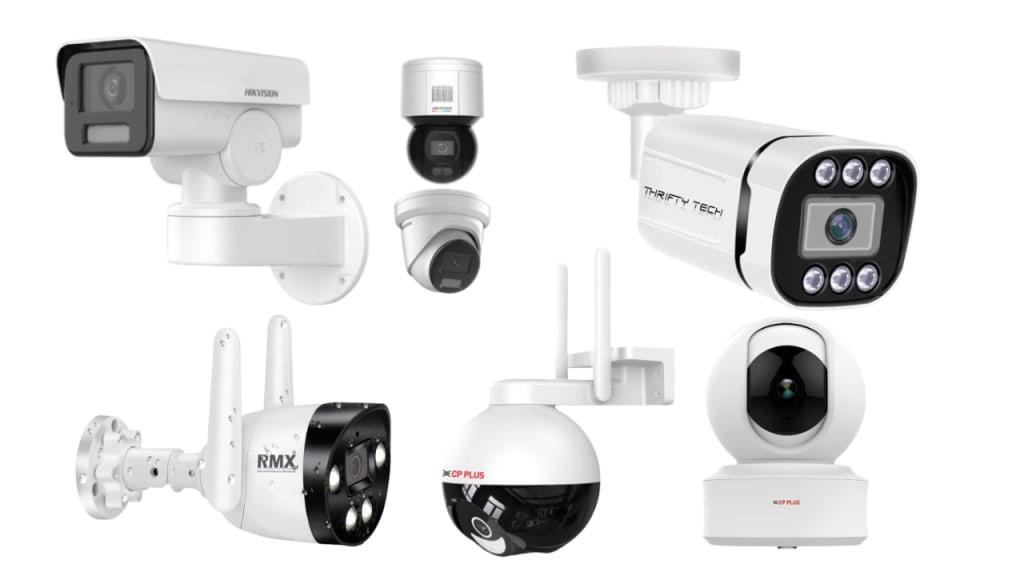
7 CCTV Camera Types in Kenya: Which One Do You Need?
Introduction
CCTV camera types Kenya businesses and property owners can choose from have different designs, features and applications.
A camera that works well inside an office may not be the best option for monitoring a large outdoor compound. Similarly, a camera suitable for a small shop may not provide the coverage required for a warehouse or hotel.
This is why choosing a CCTV camera should start with one important question:
What exactly do you need the camera to monitor?
In this guide, Marimbu Heritage Technologies explains 7 common CCTV camera types in Kenya, what each type is designed for, where you can use it and what you should consider before buying.
7 CCTV Camera Types Kenya Property Owners Should Know
There are many CCTV camera models available today, but they generally fall into several common categories.
The seven types covered in this guide are:
- Dome cameras
- Bullet cameras
- Turret cameras
- PTZ cameras
- Fisheye cameras
- Panoramic cameras
- IP/network cameras
Let’s look at each one.
1. Dome CCTV Cameras
Dome cameras have a rounded, dome-shaped design.
They are commonly used indoors and can also be suitable for some outdoor environments.
Dome cameras can be installed in places such as:
- Offices
- Shops
- Reception areas
- Schools
- Hotels
- Corridors
- Retail stores
One advantage of the dome design is that it can provide a relatively discreet appearance.
Some dome cameras also include vandal-resistant features, making them useful in areas where the camera could be physically tampered with.
When should you choose a dome camera?
A dome camera may be a good choice when you want a relatively discreet camera for an indoor or protected location.
2. Bullet CCTV Cameras
Bullet cameras have a longer, cylindrical design and are often used where a visible camera is preferred.
They are commonly used for:
- Building entrances
- Perimeters
- Parking areas
- Driveways
- Warehouses
- Outdoor walls
- Gates
Many bullet cameras are designed for outdoor use and may include features such as infrared night vision and weather resistance.
Because the camera is visually noticeable, it can also act as a visible security deterrent.
When should you choose a bullet camera?
A bullet camera can be suitable when you need to monitor a specific outdoor direction or area such as a gate, entrance or perimeter.
3. Turret CCTV Cameras
Turret cameras are another popular CCTV option.
They have a compact design and are sometimes preferred because the camera lens can be adjusted easily during installation.
Turret cameras can be suitable for:
- Shops
- Offices
- Homes
- Warehouses
- Outdoor walls
- Building entrances
They can also be available with different resolutions and night-vision technologies.
When should you choose a turret camera?
A turret camera can be useful when you want a flexible camera design for indoor or outdoor surveillance and easy adjustment of the viewing angle.
4. PTZ CCTV Cameras
PTZ stands for:
Pan – Tilt – Zoom
Unlike a fixed camera, a PTZ camera can move horizontally, move vertically and zoom into an area.
This makes PTZ cameras useful for monitoring larger areas.
They can be used in:
- Large compounds
- Warehouses
- Parking areas
- Schools
- Hotels
- Industrial facilities
- Large commercial properties
A PTZ camera can allow an authorised operator to change the viewing direction remotely.
Some advanced PTZ cameras can also include automatic tracking features.
When should you choose a PTZ camera?
A PTZ camera may be appropriate when you need to monitor a large area and require the ability to change the camera’s viewing direction.
However, a PTZ should not automatically replace fixed cameras.
A PTZ may be looking in one direction while an incident occurs outside its current field of view.
For important areas, a combination of fixed cameras and PTZ cameras may provide better coverage.
5. Fisheye CCTV Cameras
Fisheye cameras are designed to provide a very wide field of view.
Some models can provide panoramic coverage from a single mounting location.
They can be useful in:
- Retail stores
- Reception areas
- Large rooms
- Offices
- Schools
- Commercial spaces
A major advantage is the ability to monitor a large area from one camera position.
However, the image can appear distorted depending on the camera and viewing mode.
When should you choose a fisheye camera?
Consider a fisheye camera when you need wide-area coverage and want to minimise blind spots in a large indoor space.
6. Panoramic CCTV Cameras
Panoramic cameras are designed to provide very wide coverage.
Some models use multiple sensors or specialised optics to monitor a broad area.
They can be useful for:
- Large entrances
- Retail spaces
- Reception areas
- Open commercial areas
- Large indoor rooms
Instead of installing several conventional cameras, a panoramic camera may sometimes cover a wide area from a strategic position.
The correct solution depends on the required level of detail and viewing distance.
7. IP or Network CCTV Cameras
IP cameras are network-based CCTV cameras.
They transmit video over a network rather than relying on traditional analogue video connections.
An IP camera can typically connect through Ethernet to network equipment.
A common setup is:
IP Camera → PoE Switch → NVR → Network
One major advantage of IP CCTV is that it can integrate with modern network infrastructure.
IP cameras can also support features such as:
- High-resolution video
- Remote viewing
- Motion detection
- Smart analytics
- PoE
- Two-way audio on supported models
- Integration with other network systems
For modern business installations, IP cameras can be an excellent option.
CCTV Camera Types Kenya: Which One Is Best?
There is no single CCTV camera that is best for every property.
The right choice depends on:
- Where the camera will be installed
- Indoor or outdoor environment
- Required viewing distance
- Lighting conditions
- Area size
- Required image detail
- Night surveillance requirements
- Budget
- Existing network infrastructure
For example:
| Location | Possible Camera |
|---|---|
| Office | Dome or turret |
| Shop | Dome or turret |
| Gate | Bullet or PTZ |
| Parking | Bullet or PTZ |
| Warehouse | Bullet, turret or PTZ |
| Reception | Dome or fisheye |
| Large room | Fisheye or panoramic |
| Large compound | PTZ + fixed cameras |
These are general examples. A site assessment can provide a more accurate recommendation.
Dome vs Bullet vs Turret
These three camera types are commonly compared.
Dome
Best suited to:
- Indoor areas
- Offices
- Shops
- Reception areas
Bullet
Best suited to:
- Outdoor areas
- Gates
- Perimeters
- Parking areas
Turret
Can be suitable for:
- Indoor areas
- Outdoor walls
- Shops
- Homes
- Offices
The choice should be based on the installation environment rather than appearance alone.
Fixed Camera vs PTZ Camera
A fixed camera points at a specific area.
A PTZ camera can move and zoom.
Fixed Camera
Advantages:
- Constantly monitors one area
- Simple concept
- Useful for entrances and specific zones
- Can provide continuous coverage of its selected field of view
PTZ Camera
Advantages:
- Can cover larger areas
- Can zoom
- Can change direction
- Useful for active monitoring
For larger properties, using both can be beneficial.
Fixed cameras can continuously monitor important areas while a PTZ provides additional flexible coverage.
Indoor vs Outdoor CCTV Cameras
The environment matters.
An indoor camera does not necessarily have the protection required for outdoor installation.
Outdoor cameras may need features such as:
- Weather resistance
- Dust protection
- Suitable operating temperature
- Night vision
- Strong mounting
- Protection from tampering
Before installing a camera outside, check whether it is designed for the environment.
CCTV Camera Resolution: 2MP, 4MP or 8MP?
Camera type is only one part of the decision.
Resolution also matters.
Common options include:
- 2MP
- 4MP
- 5MP
- 6MP
- 8MP
Higher resolution can provide more detail, but it may also require more storage and network bandwidth.
For example, a camera monitoring a small entrance may have different requirements from one monitoring a large parking area.
Choose resolution based on the required identification distance and level of detail.
Colour Night Vision vs Infrared Night Vision
Night surveillance is important for many Kenyan businesses.
Traditional infrared cameras can provide black-and-white footage in darkness.
Some newer technologies can provide colour images in low-light conditions when sufficient illumination is available.
Colour footage can sometimes provide useful additional information, such as clothing colour or vehicle colour.
However, the actual performance depends on the camera, lighting conditions and installation environment.
What About CCTV Audio?
Some CCTV cameras support audio features.
Depending on the model, this may include:
- Built-in microphone
- Audio recording
- Two-way audio
Whether audio is appropriate depends on the application, equipment and applicable privacy requirements.
For most surveillance planning, video coverage should remain the primary consideration.
How CCTV Camera Placement Affects Performance
Even the best CCTV camera can produce poor results if it is installed incorrectly.
Consider:
- Camera height
- Viewing angle
- Lighting
- Sunlight
- Obstructions
- Distance from the target
- Potential vandalism
- Cable route
For example, pointing a camera directly toward strong sunlight can result in poor images.
Similarly, installing a camera too high may make it difficult to identify faces.
Camera placement should therefore be planned before installation.
CCTV for a Kenyan Shop
A small retail shop may need cameras covering:
- Entrance
- Cashier
- Customer area
- Stock room
- Back entrance
Dome or turret cameras may work well for many indoor locations.
An outdoor bullet camera could be considered for the entrance or parking area.
The objective should be to cover important areas without unnecessarily increasing the number of cameras.
CCTV for a Kenyan Office
An office may require cameras around:
- Main entrance
- Reception
- Corridors
- Parking
- Server/network room
- Storage areas
The exact design depends on the office layout and security requirements.
IP CCTV can be particularly useful when the business already has structured cabling and network infrastructure.
CCTV for a School
Schools may require surveillance around:
- Gates
- Administration buildings
- Corridors
- Parking areas
- Perimeter
- Common areas
Camera placement should be carefully planned to support security while respecting appropriate privacy considerations.
Large school compounds may benefit from a combination of fixed cameras and PTZ cameras.
CCTV for a Hotel
Hotels can have more complex surveillance requirements.
Potential camera locations include:
- Main entrance
- Reception
- Parking
- Corridors
- Service entrances
- Perimeter
- Other appropriate common areas
A hotel may require different camera types depending on the location.
For example, a dome camera may be appropriate for a reception area while a PTZ or bullet camera could be more suitable for an outdoor parking area.
CCTV for a Warehouse
Warehouses often have:
- High ceilings
- Large open areas
- Loading bays
- Storage aisles
- Multiple entrances
- Large outdoor compounds
Camera selection should consider viewing distance and lighting.
Long-distance areas may require cameras with suitable lenses and resolution.
How Much Do Different CCTV Cameras Cost in Kenya?
The price of a CCTV camera depends on factors such as:
- Brand
- Resolution
- Lens
- Night vision
- Weather resistance
- Smart features
- Audio
- PTZ functionality
- Storage requirements
- Installation requirements
Rather than selecting a camera based only on price, consider the complete surveillance requirement.
A cheaper camera that cannot provide useful footage may ultimately cost more when it needs to be replaced.
How to Choose the Right CCTV Camera
Before buying, ask these questions:
1. Where will the camera be installed?
Indoor or outdoor?
2. What area must it cover?
Small room or large compound?
3. How much detail is required?
General monitoring or identification?
4. What happens at night?
Is there sufficient lighting?
5. How far away is the target?
This affects lens and resolution requirements.
6. Do you need remote viewing?
If yes, network connectivity becomes important.
7. How long should recordings be stored?
This affects storage requirements.
8. Do you need audio or analytics?
Some applications may benefit from additional features.
When Should You Choose Hikvision CCTV?
Hikvision is one of the CCTV brands available in the market, with a wide range of surveillance products.
Different Hikvision cameras can provide different features and form factors, including:
- Dome
- Bullet
- Turret
- PTZ
- Fisheye
- Panoramic
- IP/network cameras
The correct model should still be selected based on the specific requirements of the installation.
At Marimbu Heritage Technologies, we can help you identify suitable CCTV equipment based on your property and security needs.
Common CCTV Camera Selection Mistakes
Choosing Only by Megapixels
Higher resolution does not automatically mean better surveillance.
Choosing the Cheapest Camera
Price should not be the only consideration.
Ignoring Night Conditions
Always consider what the camera needs to capture after dark.
Using the Wrong Camera Outdoors
Outdoor installations require suitable environmental protection.
Installing Cameras Too High
This can make identification more difficult.
Ignoring the Lens
The lens affects the field of view and viewing distance.
Forgetting Storage
Higher-resolution cameras can increase storage requirements.
Installing Without a Site Assessment
The camera should be selected based on the actual environment.
How Marimbu Heritage Technologies Can Help
Marimbu Heritage Technologies provides CCTV and security technology solutions for homes, businesses and institutions in Kenya.
We can help with:
- CCTV camera selection
- IP CCTV systems
- Hikvision CCTV solutions
- DVRs
- NVRs
- PoE switches
- CCTV storage
- Structured cabling
- Network infrastructure
- UPS and power protection
- CCTV installation and configuration
Whether you need a few cameras for a shop or a complete surveillance system for a larger property, we can help you select a solution based on your requirements.
Contact Marimbu Heritage Technologies for CCTV solutions and a quotation in Kenya.
Frequently Asked Questions
What are the main CCTV camera types in Kenya?
Common CCTV camera types include dome, bullet, turret, PTZ, fisheye, panoramic and IP/network cameras.
Which CCTV camera is best for a shop?
Dome or turret cameras can be suitable for many indoor shop applications, while bullet cameras can be useful for outdoor entrances and parking areas.
Which CCTV camera is best for a gate?
A bullet camera can be suitable for many gates, while a PTZ camera may be considered where a larger area needs to be monitored.
Are turret cameras better than dome cameras?
Neither is automatically better. The choice depends on the installation environment, viewing angle, mounting requirements and desired features.
What is a PTZ CCTV camera?
PTZ means Pan, Tilt and Zoom. A PTZ camera can move horizontally, vertically and zoom into areas of interest.
Are IP cameras better than analogue cameras?
IP cameras offer network-based connectivity and can provide high-resolution video and advanced features. However, the right system depends on the project requirements and existing infrastructure.
How many CCTV cameras do I need?
The number depends on the areas that need monitoring, camera field of view, property layout and required level of coverage.
Can CCTV cameras work at night?
Yes. Many CCTV cameras support infrared or other low-light technologies, depending on the model.
Which CCTV camera is best for a warehouse?
The choice depends on ceiling height, viewing distance, lighting and the areas that need monitoring. Bullet, turret and PTZ cameras can all be appropriate in different warehouse environments.
Conclusion
Choosing between different CCTV camera types Kenya businesses can use should start with the purpose of the camera rather than the price.
Dome cameras can be useful for offices and shops. Bullet cameras can work well for outdoor areas. Turret cameras provide another flexible option, while PTZ cameras can monitor large areas. Fisheye and panoramic cameras can provide wide coverage, while IP cameras offer network-based surveillance for modern installations.
The most important question is:
What do you need the camera to see?
Once you understand the location, viewing distance, lighting conditions, coverage requirements and security objectives, choosing the right CCTV camera becomes much easier.
Marimbu Heritage Technologies can help you plan CCTV solutions for homes, shops, offices, schools, hotels, warehouses and other properties across Kenya.